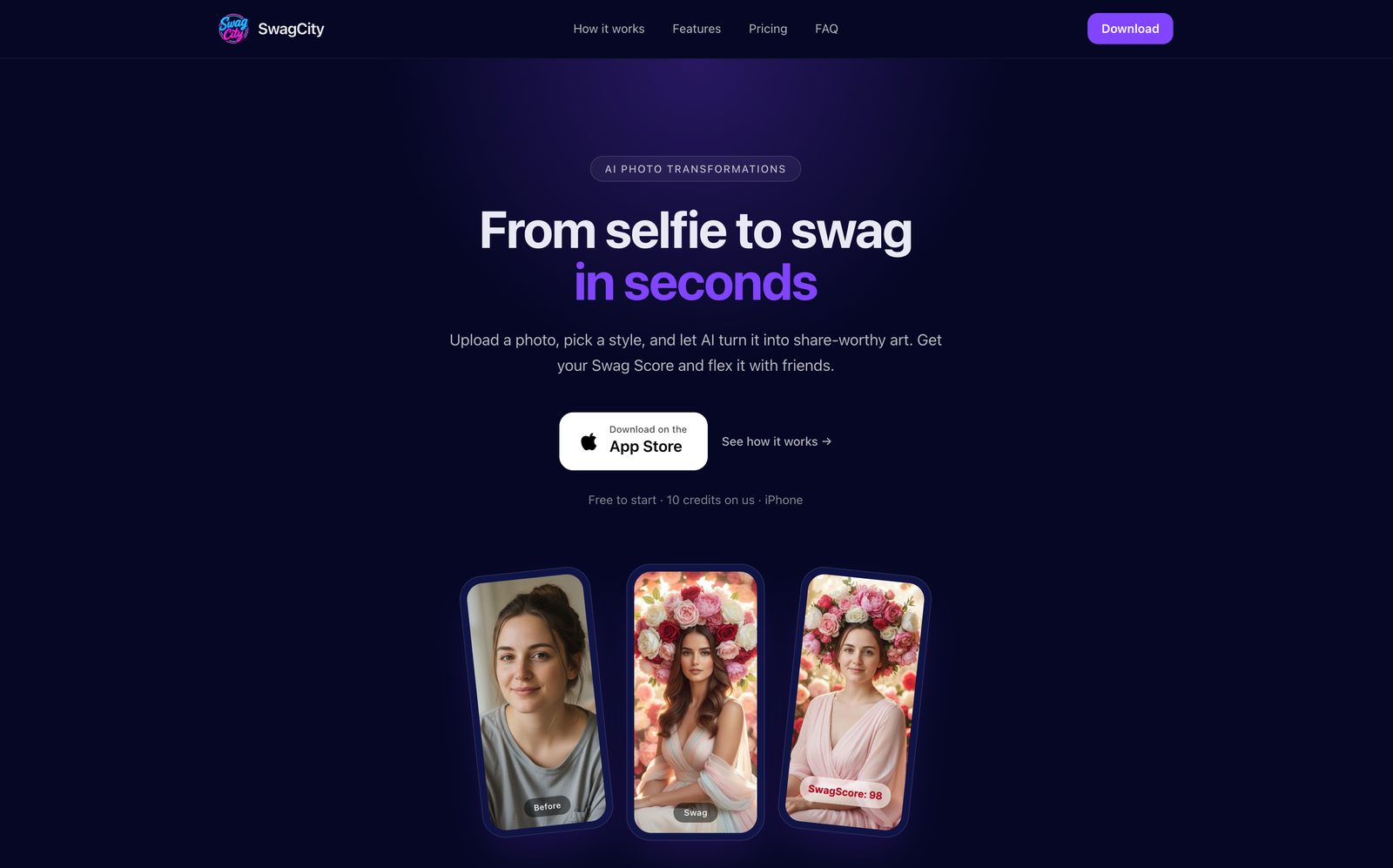
AI-powered selfie transformation
Concept to App Store submission in 7 days, solo — an AI-powered iOS app that turns a selfie into a stylised portrait, built end to end with Claude Code and ChatGPT alongside Figma, Expo and Supabase.
- Mobile App
- AI-Native
- Claude Code
- Consumer App
- Admin Dashboard
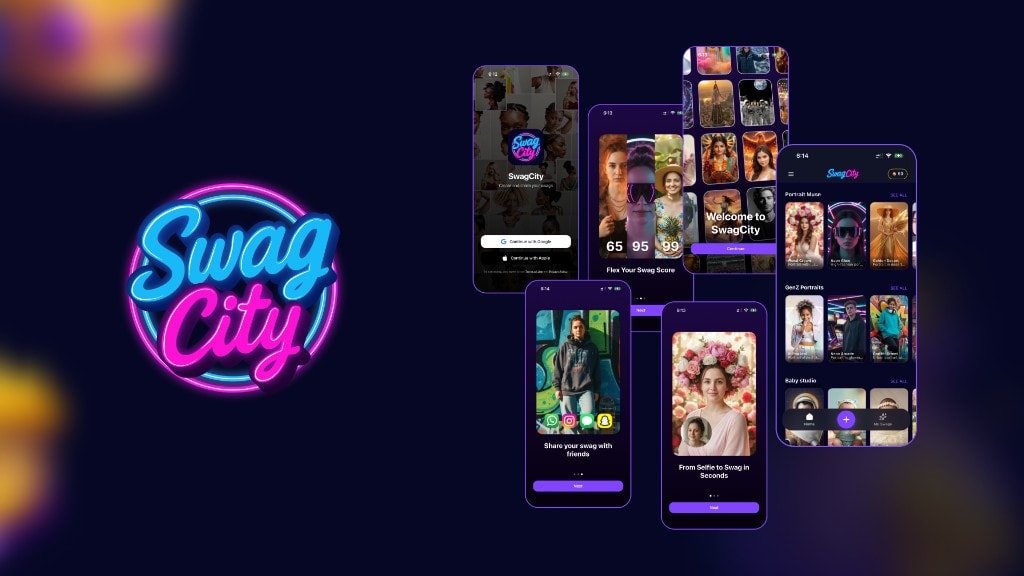
SwagCity — an AI-powered iOS app that turns a selfie into a stylised portrait — built solo, in seven days: concept to App Store submission.
I worked across brand, product strategy, UX, iOS build, backend and AI infrastructure the whole way, using Claude Code and ChatGPT as working partners throughout the build rather than adding AI in after the fact.
Solo build · 7 days, concept to submission · iOS consumer app
Project snapshot
| Roles (every minute another hat) | Founder, Brand designer, UX Researcher, Product Designers, Product Manager, Developer, Tester, Compliance Officer |
| Product | SwagCity — AI selfie-to-portrait iOS app |
| Scope | Concept, product strategy, UX/UI, iOS build, backend, AI pipeline, payments, testing, App Store submission |
| Duration | 7 days, concept to App Store submission |
| Domain | Consumer · AI · Mobile |
| Core technologies | Figma · Expo React Native · TypeScript · Supabase · Replicate · RevenueCat · Claude Code · ChatGPT |
The challenge
Every layer of a real consumer app, one person, one week.
SwagCity needed to look and feel like a trustworthy, polished consumer app — not a weekend experiment — on a timeline with no separate design phase, build phase or compliance phase. Product decisions, interface design, working code, a real payment system and Apple's App Store requirements all had to move together, from day one.
Some of the core features are
- Mobile App for consumers
- Backend Dashboard App for admins to manage styles/tokens/subscriptions
Why it was complex
Speed and craft aren't usually the same week
Most solo AI-app builds either move fast and skip the details App Review checks for, or move carefully and take months. SwagCity had to do both in the same sprint — a fast, low-friction core loop, and a fully compliant, production-grade credit and payment system.
Real money, from day one
Because the app charges for AI generations, the credit economy had to be right the first time — credits are minted server-side only, never trusted from the client, with no soft-launch period to quietly patch a broken payment flow later.
No separate research phase to fall back on
With the whole build compressed into a week, user feedback had to be gathered and acted on inside the build itself — not after a public launch.
My role
Concept to submission, one system at a time.
I owned every layer — product, design, iOS build, backend, payments, testing and the App Store submission — working solo across Figma, Claude Code, Expo, Supabase and Replicate.
Day 1 — Concept and system orchestration
Used Claude Code and ChatGPT to move from idea to a working plan fast — mapping the roadmap, the core user journey (snap a selfie, pick a style, swagify and share) and a phased build plan, and setting up how the different AI tools would work together across the rest of the build.
roadmap.md users.md phases and mvp.md wireframes brand elements
Why wireframe artefact when i can directly do prototype in claude code?
Answer is simple, i use my own low cost wireframe system to run with claude skill which is trained in creating wireframes very cost effectively.
Saving tokens :)
Day 2 — Building the app
Built the core iOS app in Expo React Native — navigation, camera and photo-library capture, and the main screens.
Expo scaffolding Iterative Builds
Day 3 — Theme and backend foundations
Built the visual theme and the Supabase backend — style and category management, a server-authoritative credit economy, and account management.
Develop theme Schema planning and supabase Batch style generation using chatgpt and openArt
Day 4 — Payments
Built the payment plans and payment gateway behind a paywall — consumable credit packs and a weekly/yearly Pro subscription via RevenueCat and Apple's in-app purchases.
Revenue cat config and setup App store product setup
Day 5 — TestFlight
Built and released the app to TestFlight for testing.
Test 1 - found many bugs and improvements
3 styles, basic paywall
Test 2 - improvements and bug fixes
60 styles, advanced paywall
Day 6 — Testing, security, compliance and submission
Ran user testing with a group of pilot users among friends and family, gathered their feedback and used it to polish the user journey; ran a security audit; worked through Apple's App Store compliance requirements — account deletion, Sign in with Apple, privacy labels; and submitted the app for App Store review.
Product Strategy iOS Development Backend & AI Pipeline User Testing
User testing
Multiple users
- 3 users on test flight, concurrent sessions, generation privacy
- RSL policies and fixing security bugs
- Fix genZ styling gaps
Impact at a glance
Concept to App Store submission in 7 days
Every layer — product, UX, iOS build, backend, AI pipeline and payments — designed and built solo, one system at a time.
Real user feedback folded into the build itself
Pilot testing with friends and family on day 6 directly reshaped the user journey before submission, not after launch.
Currently awaiting App Store review
The app has been submitted to Apple and is awaiting review. Fixing privacy policy notes.
Swagcity Website