Healthcare, Rebuilt Around AI
Led product and design from 0→1 across an AI-native healthcare ecosystem for patients and practitioners.
- AI-Native Product
- AI Product Design
- Design Engineering
- 0→1
- B2B2C SaaS
- AI Agents
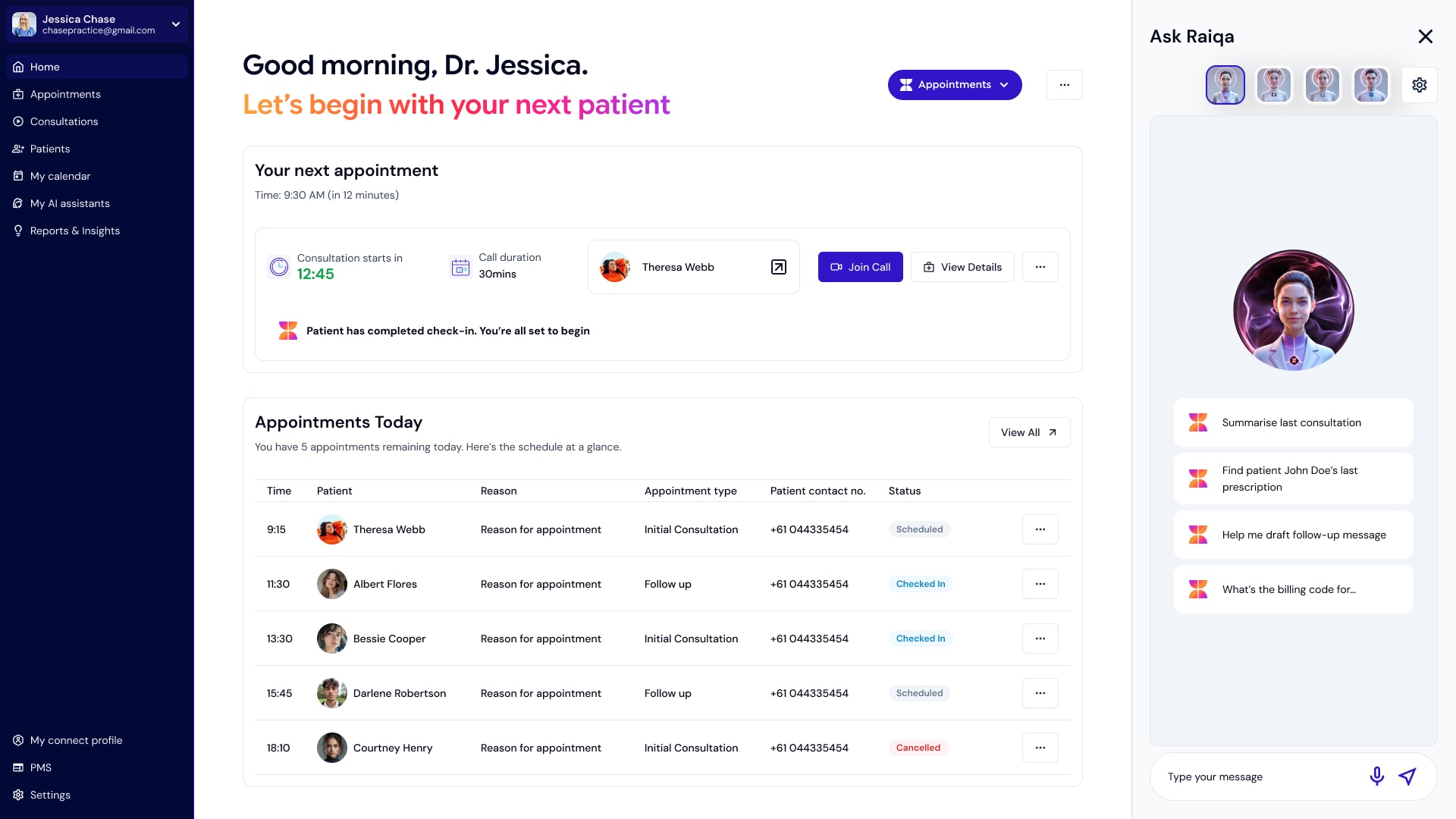
I led Raiqa Health from concept to launch — shaping the patient experience, practitioner platform and AI-assisted workflows across clinical documentation, knowledge, reception and practice operations.
I also worked directly in implementation using Claude Code and Cursor, moving between Figma, front-end code and agent logic rather than treating design and build as separate stages.
0→1 product · Patient + practitioner ecosystem · AI-native healthcare
Project snapshot
| Role | Head of Product & Design |
| Product | Raiqa Health (patient) and Raiqa Connect (practitioner) |
| Scope | Patient journeys, practitioner workflows, AI assistants, appointments, practice operations |
| Duration | 2025–2026 |
| Domain | Healthcare · AI · SaaS |
| Core technologies | Figma · React · Tailwind CSS · LangChain · n8n · Claude Code · Cursor |
The challenge
AI was easy to add. Designing healthcare around it was harder.
Patients needed a simple way to find and access care. Practitioners needed help with documentation, reception, knowledge and day-to-day administration.
AI could assist with all of these tasks — but healthcare introduced a more important question:
where should AI act, where should it assist, and where must a human remain in control?
The challenge wasn’t to put a chatbot inside a healthcare product. It was to design an ecosystem where specialised AI capabilities could become useful parts of real patient and practitioner workflows.
Why it was complex
Two sides of the same experience
Patient journeys and practitioner workflows were deeply connected. Appointments, communication and clinical activity needed to move coherently between both sides.
Different jobs needed different AI
Clinical documentation, knowledge retrieval, reception and supervision required different behaviours, context and levels of responsibility.
AI output wasn’t the final decision
Clinical workflows required practitioners to understand, review and act on AI-generated output rather than treating it as automatically correct.
From concept to working product
The work moved rapidly between product definition, UX, interaction design, AI behaviour and implementation as the product evolved from idea to launch.
My role
From product direction to working implementation.
I worked across product strategy, hands-on design, AI experience design and implementation — shaping both what the product should become and how it worked in practice.
Product Direction
Defined the product structure, priorities and experience across the patient and practitioner ecosystem.
Product Design
Designed patient journeys, practitioner workflows, information architecture, interactions and interfaces from early concepts through detailed product experiences.
AI Experience Design
Defined how specialised assistants participated in workflows, how their outputs were presented and where practitioner review and control were required.
Technical Prototyping & Build
Used Figma, Claude Code and Cursor alongside React and Tailwind to move directly from design into working front-end experiences and agent workflows.
Selected work
01 — One connected healthcare ecosystem
Connecting both sides of care.
Designed Raiqa Health and Raiqa Connect as parts of the same ecosystem — connecting patient discovery and access with practitioner workflows and practice operations.
Product Architecture Patient Journeys Practitioner UX
02 — Specialised agents, not one chatbot
Designing AI around specific jobs.
Structured the experience around specialised assistants for clinical documentation, knowledge, reception and supervision rather than asking one generic AI interface to do everything.
AI Interaction Design Agent Workflows Human-in-the-loop
03 — From Figma to working product
Closing the distance between design and implementation.
Moved directly between product design, front-end implementation and agent workflows using Figma, Claude Code, Cursor, React and Tailwind — allowing ideas to become testable product experiences quickly.
UX/UI Design Technical Prototyping AI-native Build
Impact at a glance
Connected ecosystem, not two products
Designed the patient and practitioner platforms around shared journeys rather than treating them as disconnected experiences.
Specialised AI with clear roles
Created distinct AI-assisted workflows for clinical documentation, knowledge, reception and supervision.
Humans stayed in control
Designed AI output to remain reviewable and actionable, keeping clinical judgement with practitioners.
Early evidence of operational impact
A single-practice pilot provided an early signal that AI-assisted workflows could materially reduce administrative burden while improving booking completion.
**
Early results from a single-practice pilot, not platform-wide performance.
Explore the products
Raiqa Connect
See the practitioner platform and AI-assisted practice workflows.
Raiqa Health
Explore the patient-facing healthcare experience.
Private deep dive
Go behind the decisions.
What you see here is only a glimpse of the project.
The full case study covers the original problem, what I discovered along the way, assumptions that proved wrong, directions I explored, trade-offs I made, and how feedback changed my thinking.
Request access for the complete decision trail — through to the final outcome and impact.
- Product Strategy
- Patient Journeys
- Practitioner Workflows
- AI Agents
- Human-in-the-loop
- Interaction Design
- UX/UI
- Technical Prototyping