One Platform for Financial Crime
Unified application fraud and transaction monitoring into one enterprise investigation experience, simplifying sophisticated rules, risk and ML workflows.
- SaaS
- Fintech
- Complex Workflows
- Machine Learning
- Design Leadership
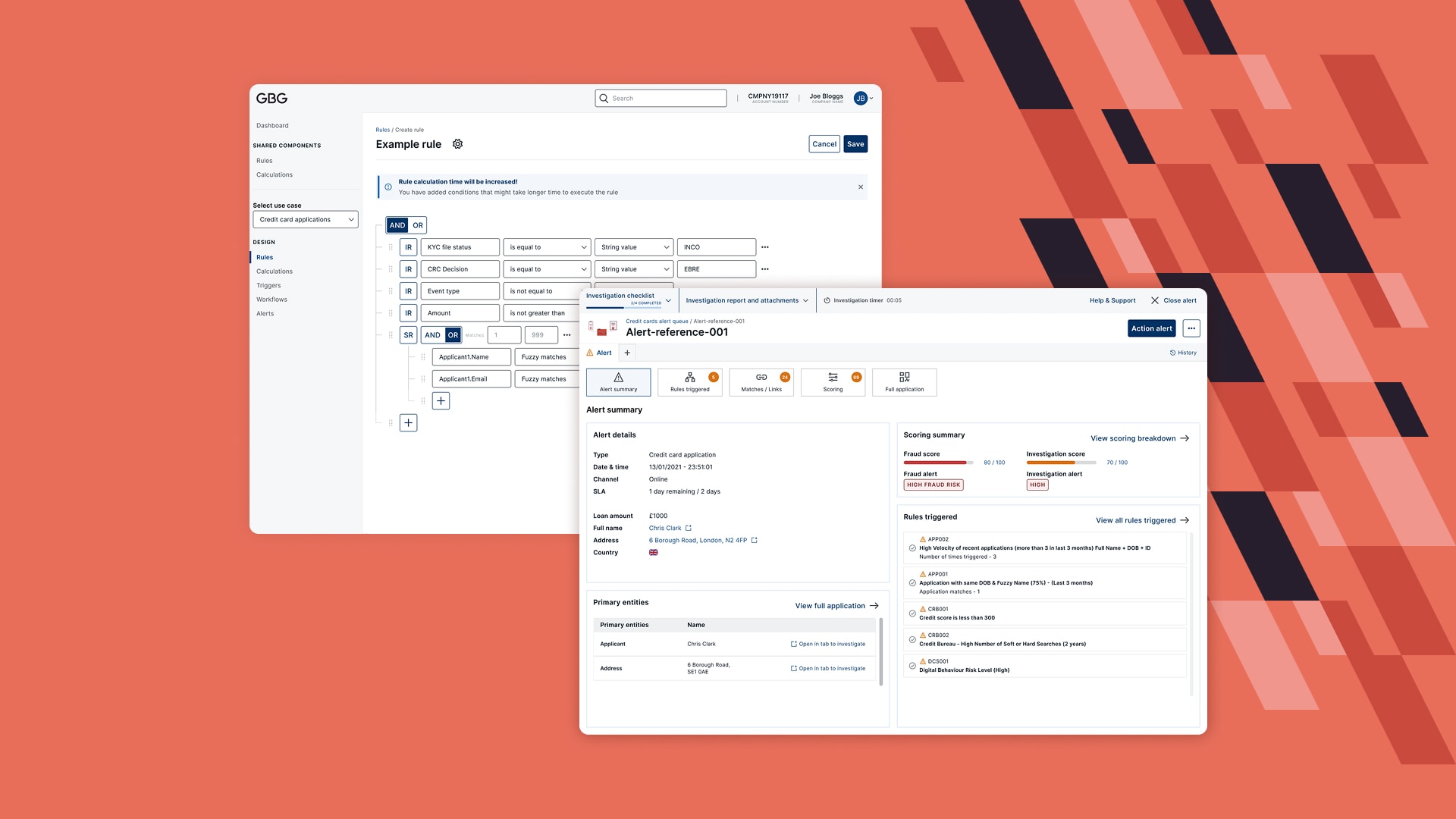
I led the design of GBG's Financial Crime Studio (FCS) — a next-generation enterprise platform unifying two disconnected products, Instinct Hub and Predator, into one investigation experience where business users could build rules, configure workflows, test scenarios and review alerts without writing code.
Outcome: Replaced two legacy fraud tools with one self-serve fraud studio built around visual rule creation, explainable machine learning and pre-deployment testing — reducing analysts' dependence on engineering and support.
Project snapshot
| Company | GBG |
| Platform | Financial Crime Studio (FCS) |
| Role | Product Design Lead |
| Scope | Unified fraud investigation, rules engine, workflow builder, risk scoring, ML decisioning |
| Team | Three Senior UX Designers, plus product, engineering and machine learning partners |
| Tools | Figma, FigJam, ProtoPie, Maze, React, Storybook |
| Skill areas | Product strategy, enterprise UX, rules design, scoring design, workflow design, AI/ML collaboration, design systems, research, leadership |
Impact at a glance
Unified two products into one studio
Merged onboarding-fraud and transaction-monitoring workflows into a single tool, so analysts stopped switching context and repeating the same investigation twice.
Built a rule builder non-technical users could trust
Replaced code-first rule creation with a visual builder — plus an expression builder for advanced users — cutting reliance on engineering for every change.
Made machine learning explainable
Translated ML outputs into human-readable evidence, confidence indicators and reviewable thresholds, so analysts could act on model output instead of treating it as a black box.
Let users test before they deployed
Built a mechanism to validate rules and scenarios against real datasets before going live, giving business users confidence in their own logic.
In short: redesigned how a global fraud platform makes decisions — turning two legacy tools and opaque ML output into one self-serve studio for building, testing and deploying fraud strategy.
Private deep dive
Go behind the product.
What you see here is only a glimpse of the project.
The full case study covers the original problem, what I discovered along the way, assumptions that proved wrong, directions I explored, trade-offs I made, and how feedback changed my thinking.
Request access for the complete decision trail — through to the final outcome and impact.
- Product Strategy
- Enterprise UX
- Rules Engine
- Workflow Design
- Risk Scoring
- Explainable AI
- Machine Learning Collaboration
- Design Systems
- Design Leadership